 NeuroGenesys
Probability & Inference
Reasoning under uncertainty: the rules of probability, Bayes' rule, why averages concentrate, and how maximum likelihood turns a model into a loss function.
4 lessons • 28 min read

- 01
Probability as the arithmetic of uncertainty
Every modern AI system that outputs a prediction, from a spam filter to a large language model, is in the business of assigning numbers to uncertain outcomes. Probability is the small set of rules those numbers must obey to stay consistent, and nearly everything else in machine learning is built on top of that arithmetic.
7 min read - 02
Bayes' rule and the base-rate trap
A detector that is right 95% of the time can still be wrong about most of the cases it flags. Bayes' rule says exactly when and by how much, and it is the single most useful formula for reading any classifier, test, verifier or evaluation result.
7 min read - 03
Expectation, variance and why averages work
How many test questions do you need before a model's benchmark score means anything? Why does a minibatch of 512 examples give a usable gradient for a dataset of billions? Both questions have the same answer: averages of independent quantities concentrate around their expectation, at a rate you can calculate.
7 min read - 04
Maximum likelihood: where loss functions come from
Squared error for regression, cross-entropy for classification, next-token log-loss for language models: these loss functions look like separate conventions, but they are one idea applied to different noise models. Maximum likelihood says to choose the parameters under which the data you actually observed would have been most probable.
7 min read
Reference videos
 15:113Blue1Brown
Bayes theorem, the geometry of changing beliefs
The base-rate trap drawn as areas. Watch alongside the Bayes' rule lesson.
Watch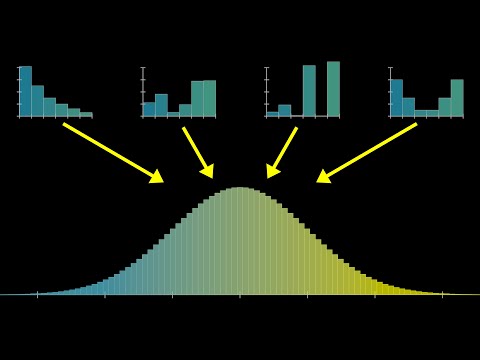 31:153Blue1Brown
But what is the Central Limit Theorem?
Why averages concentrate and why the bell curve keeps appearing.
Watch 6:12StatQuest with Josh Starmer
Maximum Likelihood, clearly explained!!!
A short, concrete picture of fitting a distribution by maximum likelihood.
Watch Series62 videosStatQuest with Josh Starmer
Statistics Fundamentals
Short, friendly episodes on distributions, p-values, likelihood and more.
Open series